Hey everyone! By now you've probably read that the 50 acres has been preserved, thanks to an amendment to the original agreement between the NJDEP, Burlington County Bridge Commission, and Tidelands. The CDF is reduced from 70 to 20 acres and "extends the life of the park by restarting the 30-year term of the agreement," according to Clara.
Congratulations to everyone who loves the park and worked hard this summer to protect it.
Showing posts with label Save Palmyra Cove Nature Park. Show all posts
Showing posts with label Save Palmyra Cove Nature Park. Show all posts
Tuesday, January 1, 2008

Monday, September 24, 2007
Can you be there?
Hello friends,
There are a couple of important meetings this week and your presence will send the message that many people are still focused on the Conservation Easement.
Burlington County Bridge Commission
Wed. Sep. 26 2 p.m.
@ the Bridge Commission
Please come to this monthly meeting to ask if the Bridge Commission has made progress in attaining the Conservation Easement. The Bridge Commission and even the DEP has both expressed their support for the protecting this 5o-acre parcel, so we just have to push it to the top of their agenda.
Wed, Sep. 26 9:30 a.m.
Tim Robinson, Burlington Cty. Soil Conservation District
@ Palmyra Cove Nature Park
I am meeting with Tim Robinson to see how his organization can help us. They have already served Lisa Jackson with a violation for the project because the DEP didn't get prior approval from Soil Conservation. They've also forced the DEP to correct the outflow pipes to decrease the amount of silt flowing back into the river. If you can make it to the meeting that would be great - the more supporters this park has the better, as you know. :)
Also, a couple of people have asked me what to do with yard signs. Clara feels the most effective strategy is for everyone to take the yard signs down until the issue over the conservation easement heats up - then they can put them up again. That would make a stronger statement than leaving them up, I think.
Thank you and I look forward to seeing many of you this week!
There are a couple of important meetings this week and your presence will send the message that many people are still focused on the Conservation Easement.
Burlington County Bridge Commission
Wed. Sep. 26 2 p.m.
@ the Bridge Commission
Please come to this monthly meeting to ask if the Bridge Commission has made progress in attaining the Conservation Easement. The Bridge Commission and even the DEP has both expressed their support for the protecting this 5o-acre parcel, so we just have to push it to the top of their agenda.
Wed, Sep. 26 9:30 a.m.
Tim Robinson, Burlington Cty. Soil Conservation District
@ Palmyra Cove Nature Park
I am meeting with Tim Robinson to see how his organization can help us. They have already served Lisa Jackson with a violation for the project because the DEP didn't get prior approval from Soil Conservation. They've also forced the DEP to correct the outflow pipes to decrease the amount of silt flowing back into the river. If you can make it to the meeting that would be great - the more supporters this park has the better, as you know. :)
Also, a couple of people have asked me what to do with yard signs. Clara feels the most effective strategy is for everyone to take the yard signs down until the issue over the conservation easement heats up - then they can put them up again. That would make a stronger statement than leaving them up, I think.
Thank you and I look forward to seeing many of you this week!
Thursday, August 30, 2007
What's happening at Palmyra Cove?
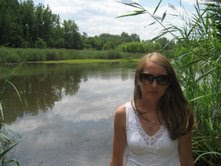
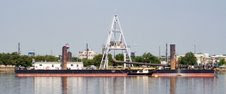
The Tacony-Palmyra Bridge's warning siren drowns out the screams of crickets; the bridge is about to open. It's 11:30 a.m. and I've just arrived at Palmyra Cove Nature Park. Standing on the beach, I'm hoping to see the McFarland, the U.S. Army Corps. of Engineers dredging barge. I catch a glimpse of yellow at the bridge breaks apart and the two sides rise into the air. It's the McFarland, about to pass through the open bridge. I grab my video camera and zoom in on the monstrous water beast. Through the viewfinder I see the white block letters stamped onto the underbelly of the black behemoth: MCFARLAND.
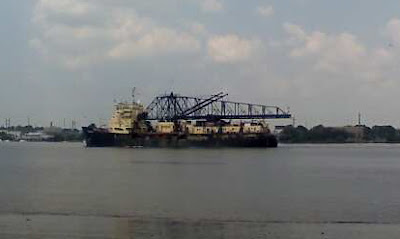 Camera rolling, I watch the monster creep up on the bridge, chugging steadily, and slip through, heading south toward the mooring barge awaiting arrival of its master. A family, three generations of nature lovers, sits on the beach and watches the gliding machine, mesmerized. I hike down the River Trail still stalking my prey; the camera is my weapon of choice. After about 10 minutes the McFarland docks into the mooring barge, the ships seeming to kiss hello as they become one.
  I pick my way through the sand, past tiny footprints that remind me of my own child, and arrive at the drainage pipes. Water gushes heavily - the color of beer or urine - from the pipes into the Delaware River. The air reeks of polluted earth; a concoction of contaminated sand, river water and diesel fuel. A long black pipe stretches into the river from the beach like the giant black tentacle of a kraken. It's marked by a giant round pink buoy. The family has left and the child's footprints washed away. A phrase springs to mind: post-modern dystopia. The juxtaposition of the man-made versus the natural leaves me feeling sick. This is all one messed-up band-aid, a temporary solution to the long-term problem of where to put dredge spoils.
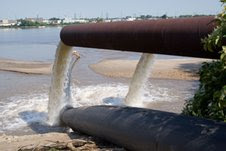 Now I have a problem. The pipes have blocked my hike. This dredging project isn't supposed to stop people from using any of the trails, but I've only been here for 15 minutes and already I'm barred from hiking into the park. Minimal impact project is the phrase they keep throwing around, but I'm trapped. I feel like the great water beast is laughing at me. Then I spot another hiker walking towards me on the other side of the pipes. He hops onto and then over the great black pipe and I compliment his spryness. His name is Kevin and we find out we have a mutual friend: the indefatiguable Fred Stine of the Delaware Riverkeeper Network. (The community of environmentalists is a closely-knit one in this region.) We talk together as we watch the barges and he explains that the McFarland dumps its sand into the great black hose of the mooring barge. The hose, reminiscent of the basilisk in Harry Potter and the Chamber of Secrets, snakes along the river floor and emerges about 150 feet from where we stand on the beach. Serpentine, its great body basks in the hot sun hundreds of feet into the park area formerly known as the desert. I give Kevin CAN's contact info and continue my monitoring mission to the tune of grumbling ships and insect symphonies.
As I follow the beast's tubular body into my beloved park, I am surprised to see vehicles driving on the trails and parked next to the work area. A mound of red gravel had been built on top of the black hose to allow these vehicles to drive to and from the work site over the hose. I turn my eyes to the ground and I see bulldozer tracks. It's churned up the grasslands area near the area where CAN's members have protested two weeks ago. Deep gashes, three inches deep and two inches wide, mark the bulldozer's course. Bushes are crushed beneath the basilisk's body. I straddle the hose to cross over it - it's like sitting on the back of an elephant. I approach the work site and wary workmen cautiously wave hello. The bulldozer dozes; it's the lunch hour. I say hello to the men.
"You were one of those protesters, weren't you? You had your kid with you. I was driving the bulldozers," one of the men ventures.
"Yes, I was and I remember you. I was yelling Save the Cove! at your bulldozer and you got out and told me you were 'just doing your job,'" I said. "Just so you know, we're not against the dredging, we just don't want it dumped here. This is the problem with Jersey - there are too many people and nowhere to put this stuff." Another man walked up and heard the last part of my comment.
He said, " There's nowhere to put it around here. But there are plenty of places farther south down the river, like Pedricktown. That site can hold 2400 acres. The government used to test Nike missiles there and it's owned by the U.S. government." [I have since found out this site is one of the most ecologically vibrant natural places in NJ and must be protected - the worker didn't know what he was talking about.]
I questioned him further. "Why hasn't it been used before?"
"It would take the barge 3 or 4 hours to get down there. It's too time consuming and expensive," he explained. Then he went on to talk about how he heard the the environmentalists really laid Charlie Myers, the Army Corps' project manager, at the Public Information Session on August 13. I smiled proudly and told him I was one of those people.
A minute later, I say good-bye to the workers and turn my eyes to the scene before me. What was the desert is now a cappuchino-colored mud pit. It's heartbreaking. I think I'm going to be sick. I remember my first meeting with CAN; walking across this trail with the three environmental teachers, Suzanne, Anjie and Bernie. They pointed out fox holes and footprints; the area was a rich and diverse ecosystem. Now it has been slathered with wet, contaminated mud. Picture a sandbox after a rainstorm. Trees are waist deep in water. Mud strangles their trunks. Will they survive? Where are the fox now? Elegant yellow leaves fall to the mud floor and get stuck here; the seasons march on, relentlessly.
 Suddenly moving water rushes across the plain, giving the illusion of a stream. It flows into the fragmites, which acts as a natural filter and is one of the reasons this parcel makes such an effective dump site. Darn invasive species. Other workers are milling around and I ask them where the drain pipes are.
"The sluicebox? Follow the orange fence around the bend and it's on the right," one replies.
As I follow the orange fence, I'm struck once again by the almost gothic combination of sounds - insects chirping, the stream's song, and the barge's bass. The park trembles. The muddy desert has changed into a far-reaching field of fragmites. In the distance, I see the same orange fence marking the perimeter of the 20-acre work area. When I get to the sluicebox I see a wooden walkway streatching from the trail to the framed of the sluicebox, which reminds me of an unfinished shed. Two NO TRESPASSING SIGNS warn park users to stay away. The sluicebox structure is 12-foot by 12-foot by 12-foot cube, by my estimation. The floor is covered in mud and I hear water falling. I can't see the pipes but I envision their double gaping mouths, hungry to suck up the river water. I hear the bulldozer roar to life and I feel nauseous again. I see a delicate white butterfly and hear an animal scurrying in the underbrush inside the fence. It gives me a moment of hope that the fox are still around, but then I worry that they're stuck inside the work area.
To the right of this path, near the junction of the Saw Whet trail, lives a young forest. Peering under its canopy, I see birds and insects. This thriving ecosystem gives me hope - it, at least, remains untouched. This is part of the 50 acres CAN helped save.
I decide to walk back to the worksite; as I turn to go I hear a smaller bulldozer approaching from the young forest, driving out of the Saw Whet trail. A second bulldozer. I hike back to the worksite and see a John Deere tractor and I think that modes of transportation are one of the issues that divides "us" from "them." We travel via foot and golf cart; they choose SUVs, trucks, and tractors. There's something so natural and flowing about hiking books and even quiet golf carts. But the sight of these huge, roaring, polluting machines angers me; they don't belong in a nature park.
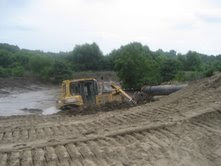 I hike up a little hill, the entrance to the work site, and stand on an overlook. The destruction spreads out before me, tall mounds of mud; flowing polluted water; a bulldozer pushing it toward the drainage pipes. I think about Freeholder Haines letter (See previous blog entry in red): The original vision of this park was for nature and technology (dredge spoils) to coexist peacefully, he wrote. But that was an impossible vision - the two are incompatible. The people who enjoy this park are disgusted by the dredge silt, the bulldozers, the destruction. We have to prevent this from ever happening in the park again. Like any growing, changing, entity, the park has risen above and beyond its original potential. It broke free of man-imposed restraints.
A third bulldozer disturbs my thoughts and I have to scurry to get out of its way as it rumbles toward my perch overlooking the desert. After the bulldozer parks, I pick my way down the trail toward the last checkpoint on my surveillance session, Dragonfly Pond. I want to see for myself if Commissioner Jackson's workmen are honoring her promise to protect the wetlands. This trail has been ripped up by the bulldozers. Have you ever seen the columns icon on MS Word? That's what this trail looks like - two columns of deep wounds on either side of the trail. It's scarred.
I walk down the little hill toward the pond and I'm not prepared for what I see. The pond has swollen - it's dark brown and some strange liquids that resemble diesel fuel are floating on its surface. The path to the right, which used to lead into the desert, is submerged with the same brown liquid. Again, I wonder what's happened to the fox. Last time I was here, at least half a dozen birds were playing and bathing in the pond. Now, there are no birds in sight and I can't even hear any singing. Another SUV drives down the trail above me.
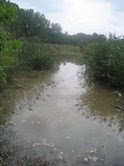 As I descend to get a closer look at the damage on Dragonfly Pond, I heard three loud plops into the water. The frogs are still here. I see a few dragonflies as well. A huge truck drives by. I lean over to look at that strange liquid and more frogs jump into the water; they seem more skittish than usual. Their environment - their world - has been forever altered by humans. Only nature can repair it and I'm confident she'll regenerate, grow, rise again. That nature will recover isn't a possibility - it's a certainty. The park is in her hands now.
 E-mail the author, Courtney McLaughlin at savethecove@gmail.com. Thanks to Bennett Landsman, Dan Homan and Jane Nogaki for taking these wonderful photos.
Monday, August 13, 2007
Bulldozers tomorrow morning at sunrise
Tomorrow morning is a pivotal day for Palmyra Cove Nature Park. Bulldozers will roll in just after sunrise - and we'll be there to face them. We'll be asking questions - and hopefully getting some better answers than the NJ DEP and Army Corp. gave us today.
The press will also be there to publicize our efforts. Bring your yard signs and even if you can't get there at sunrise, please come out to the nature park to show your support for the park's protection.
Public Information Session
I am so proud of the park's supporters! Over a hundred people showed up to ask tough questions and voice their opposition to the "compromise," including local residents, the major of Palmyra, delagates from the Sierra Club, the NJ Audubon Society, NJ Environmental Federation and Maya van Rossum, the Delaware Riverkeeper. About a dozen reporters covered the event,
Unfortunately, the NJDEP and Army Corps talked around our questions.
Lisa Jackson - NJDEP Commissioner
During her 20 minute appearance at the meeting, Lisa Jackson said PCNP is held in trust by the state of NJ for the people of the state and that it belongs "to the people of New Jersey." Yet hundreds of NJ's people oppose the plan to dump on the park.
You might expect these agencies to use PowerPoint or Keynote to make their plans clear, but they chose instead to use printed maps, which were impossible for anyone to see. When Ms. Jackson pointed out the 20-acre area for dredge spoils, she said "it includes a pond...I think it has a name.." and the audience shouted out "Dragonfly Pond!" It was a proud moment for us.
She also clarified the nature of the project: EMERGENCY dredging. (Not deepening or maintenance dredging). This title basically gives them the right to do whatever they want, despite the public's concern or case law.
She also said "I support an amendment to the current management agreement taking 50 acres of land off the table." However, the next commissioner can amend it again and use the 50 acres. In order to save that 50 acres forever, a deed restriction/ conservation easement is necessary. Getting this needs to be our long term goal.
Other particulars:
-The project will remove 55,000 cubic yards of sand
-The project will take about 30 working days - starting tomorrow (with dredging to begin next week)
-The project will cost $2.3 million to remove 55,000 cubic yards
Charlie Myers - Project Manager, U.S. Army Corps. of Engineers
Myers claims to have "looked at" existing disposal sites from Allegheny Ave to Trenton and dismissed. He said Hawk Island and Burlington Island can't be used because of "lack of maintenance" and later accused the state of letting the island fall into this state. (There's no money in the budget for maintaining the sites).
He also said the Money Island site was out of commission due to last year's storms. However, we've learned that the site was used for dredge spoils just 6 months ago and that the PADEP could issue permits and prepare the site quickly to accommodate the "emergency" dredging.
The press will also be there to publicize our efforts. Bring your yard signs and even if you can't get there at sunrise, please come out to the nature park to show your support for the park's protection.
Public Information Session
I am so proud of the park's supporters! Over a hundred people showed up to ask tough questions and voice their opposition to the "compromise," including local residents, the major of Palmyra, delagates from the Sierra Club, the NJ Audubon Society, NJ Environmental Federation and Maya van Rossum, the Delaware Riverkeeper. About a dozen reporters covered the event,
Unfortunately, the NJDEP and Army Corps talked around our questions.
Lisa Jackson - NJDEP Commissioner
During her 20 minute appearance at the meeting, Lisa Jackson said PCNP is held in trust by the state of NJ for the people of the state and that it belongs "to the people of New Jersey." Yet hundreds of NJ's people oppose the plan to dump on the park.
You might expect these agencies to use PowerPoint or Keynote to make their plans clear, but they chose instead to use printed maps, which were impossible for anyone to see. When Ms. Jackson pointed out the 20-acre area for dredge spoils, she said "it includes a pond...I think it has a name.." and the audience shouted out "Dragonfly Pond!" It was a proud moment for us.
She also clarified the nature of the project: EMERGENCY dredging. (Not deepening or maintenance dredging). This title basically gives them the right to do whatever they want, despite the public's concern or case law.
She also said "I support an amendment to the current management agreement taking 50 acres of land off the table." However, the next commissioner can amend it again and use the 50 acres. In order to save that 50 acres forever, a deed restriction/ conservation easement is necessary. Getting this needs to be our long term goal.
Other particulars:
-The project will remove 55,000 cubic yards of sand
-The project will take about 30 working days - starting tomorrow (with dredging to begin next week)
-The project will cost $2.3 million to remove 55,000 cubic yards
Charlie Myers - Project Manager, U.S. Army Corps. of Engineers
Myers claims to have "looked at" existing disposal sites from Allegheny Ave to Trenton and dismissed. He said Hawk Island and Burlington Island can't be used because of "lack of maintenance" and later accused the state of letting the island fall into this state. (There's no money in the budget for maintaining the sites).
He also said the Money Island site was out of commission due to last year's storms. However, we've learned that the site was used for dredge spoils just 6 months ago and that the PADEP could issue permits and prepare the site quickly to accommodate the "emergency" dredging.
Friday, August 10, 2007
Reaction to NJDEP's news
I am shocked and angered that the DEP has made the decision to clear-cut, dig, and dump in 20 acres of Palmyra Cove Nature Park. Everything in the park is interconnected and the destruction of the Dragonfly Pond ecosystem will negatively impact every acre.
I don't see the 20-acre plan as a compromise - rather, it compromises the entire park.
Here are some of the questions I want to get answers to on Monday morning:
-What kind of wildlife relocation plan does the DEP plan to pursue? Have they even thought about that or are they just going to dump sand all over our frogs?
-Why can't one of the other dredge sites take this mere 20-acre portion of spoils? The entire park is going to be damaged because of just 20 acres - that doesn't make sense at all.
-What is the timeline for this? When will bulldozers be in the park?
-Why is the DEP holding the Public Information Session on a Monday morning when most people are at work?
-Is the DEP going to promise, IN WRITING, that the other 50 acres are going to be protected and unused FOREVER?
I refuse to give up hope - bulldozers have't begun their work yet and that means the park is still intact right now. If there's a silver lining to the DEP's announcement, it's that it will galvanize all of the people who are against this action and spur them to come to the meeting. See you there, friends!
I don't see the 20-acre plan as a compromise - rather, it compromises the entire park.
Here are some of the questions I want to get answers to on Monday morning:
-What kind of wildlife relocation plan does the DEP plan to pursue? Have they even thought about that or are they just going to dump sand all over our frogs?
-Why can't one of the other dredge sites take this mere 20-acre portion of spoils? The entire park is going to be damaged because of just 20 acres - that doesn't make sense at all.
-What is the timeline for this? When will bulldozers be in the park?
-Why is the DEP holding the Public Information Session on a Monday morning when most people are at work?
-Is the DEP going to promise, IN WRITING, that the other 50 acres are going to be protected and unused FOREVER?
I refuse to give up hope - bulldozers have't begun their work yet and that means the park is still intact right now. If there's a silver lining to the DEP's announcement, it's that it will galvanize all of the people who are against this action and spur them to come to the meeting. See you there, friends!
Wednesday, August 8, 2007
Press interview updates
Good morning friends!
Did everybody see the cove made the front page of the Burlington County Times yesterday? The theme was "no news is good news," in other words - no bulldozers spell good news for the nature park. Here's a link: http://www.phillyburbs.com/pb-dyn/news/112-08072007-1389241.html
Yesterday I had conversations with two reporters, one from Moorestown's News-Weekly and another from the Philadelphia Inquirer. Both reporters seemed genuinely concerned about the fate of the park.
News-Weekly interview
Staff writer Rick Murray interviewed me over the phone yesterday morning. It was a quick interview - he wanted to know about the rally we had planned while we thought the bulldozers would be in the park. I told him that we decided to use the meeting as a brainstorming session instead of a rally and our goals are to get a public hearing and reach out to as many organizations as possible to protect the park. Rick was very polite and had some smart suggestions on some local politicians we should contact about the issue. He was also very well-informed about the issue. Look for his article this week!
Philadelphia Inquirer interview
This second interview took place at the park and was much longer. Sam Dangremond, a writing student from the University of Pennsylvania who is interning at the Inquirer this summer, came out to the park at 10:30 a.m. I requested he bring a photographer and he did, a nice guy (wearing hiking boots) named Ron. Both men were very, very curious about why the NJDEP would want to dump the dredge in the nature park. I gladly told the story from the beginning, starting with the 1998 signed agreement - our biggest obstacle. Although I gave a lot of background information, I made sure to state CAN's positions clearly and often. I told Sam we're working for this mission: Awareness. Activisim. Alternatives.
After slathering ourselves with bug spray, we walked down to Dragonfly Pond where thousands of the pond's namesake creatures mingled with geese, frogs and a great blue heron. I explained that this 22-acre site is at the very heart of the park and showed him a trail map outlining the threatened area. Interesting enough, Sam shared with me some information. He said he had called the NJDEP and the Army Corps and the only thing they would say is "No decision has been made." That's it. Just one line. I expressed my frustration at their reluctance to communicate further and talked about how CAN wants Senator Lautenberg to get a public hearing.
Sam asked the most important question of all "What exactly will happen to this place if the dredge gets dumped here?" That was the perfect lead-in to talk about how the last environmental impact study was done in 1977 and that we need a new one.
The photographer took some great images of Dragonfly Pond and the Discovery Center. The tour ended in the air-conditioning (a godsend) of the Discovery Center, where Sam and I used the interactive exhibits to learn about the dredging process. It was a poignant moment, since by this point Sam realized that trees would have to be cut down, frogs killed, geese displaced and an environmental classroom erased in order for it it all to happen.
I asked Sam when the article will run and he said "As soon as tomorrow" but he thinks his editor might want to wait until something happens at the NJDEP/Bridge Commission meetings. I'll keep you posted.
Did everybody see the cove made the front page of the Burlington County Times yesterday? The theme was "no news is good news," in other words - no bulldozers spell good news for the nature park. Here's a link: http://www.phillyburbs.com/pb-dyn/news/112-08072007-1389241.html
Yesterday I had conversations with two reporters, one from Moorestown's News-Weekly and another from the Philadelphia Inquirer. Both reporters seemed genuinely concerned about the fate of the park.
News-Weekly interview
Staff writer Rick Murray interviewed me over the phone yesterday morning. It was a quick interview - he wanted to know about the rally we had planned while we thought the bulldozers would be in the park. I told him that we decided to use the meeting as a brainstorming session instead of a rally and our goals are to get a public hearing and reach out to as many organizations as possible to protect the park. Rick was very polite and had some smart suggestions on some local politicians we should contact about the issue. He was also very well-informed about the issue. Look for his article this week!
Philadelphia Inquirer interview
This second interview took place at the park and was much longer. Sam Dangremond, a writing student from the University of Pennsylvania who is interning at the Inquirer this summer, came out to the park at 10:30 a.m. I requested he bring a photographer and he did, a nice guy (wearing hiking boots) named Ron. Both men were very, very curious about why the NJDEP would want to dump the dredge in the nature park. I gladly told the story from the beginning, starting with the 1998 signed agreement - our biggest obstacle. Although I gave a lot of background information, I made sure to state CAN's positions clearly and often. I told Sam we're working for this mission: Awareness. Activisim. Alternatives.
After slathering ourselves with bug spray, we walked down to Dragonfly Pond where thousands of the pond's namesake creatures mingled with geese, frogs and a great blue heron. I explained that this 22-acre site is at the very heart of the park and showed him a trail map outlining the threatened area. Interesting enough, Sam shared with me some information. He said he had called the NJDEP and the Army Corps and the only thing they would say is "No decision has been made." That's it. Just one line. I expressed my frustration at their reluctance to communicate further and talked about how CAN wants Senator Lautenberg to get a public hearing.
Sam asked the most important question of all "What exactly will happen to this place if the dredge gets dumped here?" That was the perfect lead-in to talk about how the last environmental impact study was done in 1977 and that we need a new one.
The photographer took some great images of Dragonfly Pond and the Discovery Center. The tour ended in the air-conditioning (a godsend) of the Discovery Center, where Sam and I used the interactive exhibits to learn about the dredging process. It was a poignant moment, since by this point Sam realized that trees would have to be cut down, frogs killed, geese displaced and an environmental classroom erased in order for it it all to happen.
I asked Sam when the article will run and he said "As soon as tomorrow" but he thinks his editor might want to wait until something happens at the NJDEP/Bridge Commission meetings. I'll keep you posted.
Friday, August 3, 2007
Cove Action Network: Now recruiting!
Hello friends!
This project has officially become my full-time (unpaid) job! As I was driving to the beach last night with my 2-year-old son and my husband Nick, I got a phone call from our friend and ally Fred Stine of the Delaware Riverkeepers. (Find out more about the riverkeepers by clicking on the link to the right.) Fred and our other advocates had just finished up a conference call discussing the feasability of getting a restraining order to protect the park. Unfortunately, the lawyers he talked to said it wouldn't work, but this creative thinking sets an example for how we have to approach this problem. Fred is going to send out an alert to the Riverkeepers' support network as well as that of the NJ Audubon Society to get them involved in our efforts as well.
Fred also reported some news we both consider outrageous - the last time an environmental impact study was done on the park was back in 1977. Appalling. So how will the Army Corps. even know what it's tearing down if a recent study hasn't been done? Fred also said the Army Corps has not clearly stated where the dredging needs to be done - at first it was 6 miles north of the Tacony-Palmyra Bridge, and now it's right under the bridge. Fred also said the Army Corps. is now talking about taking a total of 90 acres for dredge waste. Once again, it all goes back to the need for a public hearing to get this information out in the open.
Other updates
-I've been contacting hundreds of volunteers who want to help us out. This morning I talked to a guy named Matt from Palmyra who has a lot of experience organizing rallies and protests, so I think we will be prepared in case we get word about bulldozers coming in the park sometime in the future.
-Marlene from Delanco and I discussed planning a benefit concert and art exhibit at PCNP to raise public awareness of the park's fate. What do you guys think?
-Faith sent out an e-mail to her contacts inviting them to join CAN. Welcome to the blog, friends!
-Philadelphia Greenfest: We should get a table at this event to recruit volunteers for C.A.N. It's September 9 on South Street. I'm going to be there anyway showing off my greasecar (it runs on veggie oil). Would anyone else like to volunteer to sit at the table and recruit? Email me at savethecove@yahoo.com if you're up for that.
Enjoy your weekends and I'll see you on Monday!
This project has officially become my full-time (unpaid) job! As I was driving to the beach last night with my 2-year-old son and my husband Nick, I got a phone call from our friend and ally Fred Stine of the Delaware Riverkeepers. (Find out more about the riverkeepers by clicking on the link to the right.) Fred and our other advocates had just finished up a conference call discussing the feasability of getting a restraining order to protect the park. Unfortunately, the lawyers he talked to said it wouldn't work, but this creative thinking sets an example for how we have to approach this problem. Fred is going to send out an alert to the Riverkeepers' support network as well as that of the NJ Audubon Society to get them involved in our efforts as well.
Fred also reported some news we both consider outrageous - the last time an environmental impact study was done on the park was back in 1977. Appalling. So how will the Army Corps. even know what it's tearing down if a recent study hasn't been done? Fred also said the Army Corps has not clearly stated where the dredging needs to be done - at first it was 6 miles north of the Tacony-Palmyra Bridge, and now it's right under the bridge. Fred also said the Army Corps. is now talking about taking a total of 90 acres for dredge waste. Once again, it all goes back to the need for a public hearing to get this information out in the open.
Other updates
-I've been contacting hundreds of volunteers who want to help us out. This morning I talked to a guy named Matt from Palmyra who has a lot of experience organizing rallies and protests, so I think we will be prepared in case we get word about bulldozers coming in the park sometime in the future.
-Marlene from Delanco and I discussed planning a benefit concert and art exhibit at PCNP to raise public awareness of the park's fate. What do you guys think?
-Faith sent out an e-mail to her contacts inviting them to join CAN. Welcome to the blog, friends!
-Philadelphia Greenfest: We should get a table at this event to recruit volunteers for C.A.N. It's September 9 on South Street. I'm going to be there anyway showing off my greasecar (it runs on veggie oil). Would anyone else like to volunteer to sit at the table and recruit? Email me at savethecove@yahoo.com if you're up for that.
Enjoy your weekends and I'll see you on Monday!
Thursday, August 2, 2007
Save Palmyra Cove Nature Park - latest news
Thanks to everyone who called me today to get involved in saving Palmyra Cove Nature Park, including Steve from Palmyra and Marlene from Delanco. There have been so many tense moments this week, especially when we thought the bulldozers would be in the park on Monday, but there have also been so many hopeful conversations with people working hard to protect Palmyra Cove Nature Park. So thanks for the inspiration. I also want to thank Joann and June for their hard work on making flyers.
Here's the latest news:
-Bye, bye bulldozers! We received word from Senator Lautenberg's office , which was confirmed by NJDEP Commissioner Lisa Jackson that no DEP/Corps. bulldozers will be in the park on Monday morning! Since everybody worked so hard to create flyers and alert their phone/email trees, we are going to meet in the park as planned. (See blog entry entitled "Save the Cove Picnic" for details)
-The law(yer) is on our side: Today, the Bridge Commission sent a lawyer to meet with the DEP in Trenton to attempt to resolve the issue. We wish him luck and as soon as I hear (through my extremely long grapevine) what progress was made I will let you know.
*Disclaimer: This blog is not affiliated with Palmyra Cove Nature Park.
Here's the latest news:
-Bye, bye bulldozers! We received word from Senator Lautenberg's office , which was confirmed by NJDEP Commissioner Lisa Jackson that no DEP/Corps. bulldozers will be in the park on Monday morning! Since everybody worked so hard to create flyers and alert their phone/email trees, we are going to meet in the park as planned. (See blog entry entitled "Save the Cove Picnic" for details)
-The law(yer) is on our side: Today, the Bridge Commission sent a lawyer to meet with the DEP in Trenton to attempt to resolve the issue. We wish him luck and as soon as I hear (through my extremely long grapevine) what progress was made I will let you know.
*Disclaimer: This blog is not affiliated with Palmyra Cove Nature Park.
Subscribe to:
Posts (Atom)